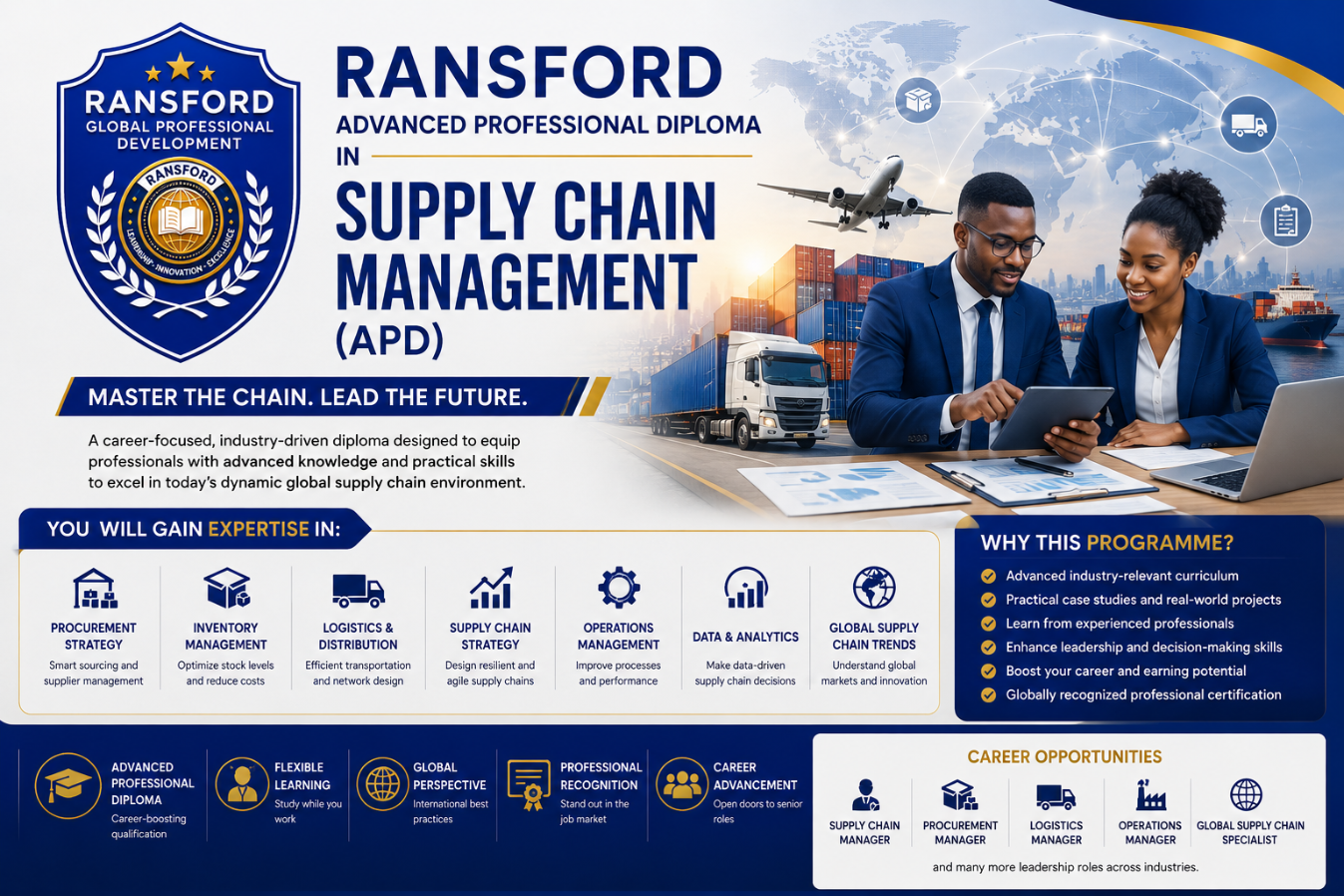
Advanced Professional Diploma
in Supply Chain Management
Build world‑class supply chain expertise with a comprehensive 4‑week, self‑paced Advanced Professional Diploma. 12 standard modules with 6 units each – covering foundations, procurement, inventory, logistics, operations, information systems, global trade, risk, sustainability, leadership, finance, and a capstone project. Expert‑led support via WhatsApp. Includes professional development training documents.
🔵 CIRCLE 1
Foundations, Operations & Technology (6 Modules)
🔵 CIRCLE 2
Global, Risk, Leadership & Capstone (6 Modules)
💰 Programme Investment
Application fee included.
Contact admissions for custom schedule.
Why choose the Advanced Professional Diploma in Supply Chain Management?
4‑Week Comprehensive
Complete the diploma in four weeks – deep, immersive learning with ample time for mastery.
Self‑Paced & Expert‑Led
Study on your own schedule, with direct expert support via WhatsApp for questions and guidance.
Holistic SCM Coverage
From foundations and procurement to global logistics, risk, sustainability, leadership, and a capstone project – 12 modules covering the full spectrum.
Practical & Applied Focus
Learn strategic sourcing, inventory optimization, logistics planning, risk assessment, sustainability, and digital transformation for real‑world application.
Complete Training Documents
Receive handbooks, worksheets, action plans, and assessment tools.
Advanced Professional Diploma
Earn an advanced diploma to elevate your SCM career and professional credentials.
🎯 Learning Outcomes
- Demonstrate advanced knowledge of supply chain principles, functions, and performance metrics.
- Apply strategic procurement, sourcing, and contract management in complex supply chains.
- Design and optimize logistics, transportation, and warehouse operations.
- Leverage digital technologies, AI, and data analytics for supply chain excellence.
- Identify, assess, and mitigate supply chain risks and disruptions.
- Integrate sustainability, ESG, and ethical practices into supply chain strategy.
- Lead high‑performing supply chain teams and drive organizational change.
- Develop and present a comprehensive, integrated supply chain strategy.
💼 Career Opportunities
- Supply Chain Director / Manager
- Chief Procurement Officer
- Logistics & Distribution Manager
- Warehouse Operations Manager
- Inventory and Materials Manager
- Global Supply Chain Consultant
- Risk and Compliance Manager
- Sustainability / ESG Supply Chain Lead
- Operations and Production Manager
- Digital Supply Chain Transformation Lead
- International Trade and Customs Manager
- Supply Chain Analytics Specialist
📘 Professional Development Training Documents
1. Programme Overview
- Course Handbook / Programme Guide
- Training Syllabus & Curriculum
- Programme Schedule / Calendar
2. Learning Materials
- Lecture Notes / Module Manuals
- Presentation Slides (PowerPoint)
- Reading Materials / Articles
3. Practical Application Tools
- Mastery Worksheets
- Case Study Exercises
- Simulation / Practical Tasks
4. Personal Development Tools
- Personal Action Plan
- Goal Setting Templates
- Reflection Journals / Logbooks
5. Assessment & Evaluation
- Pre‑Assessment / Diagnostic Test
- Continuous Assessment Tasks
- Practical Skills Checklists
- Final Assessment / Examination
- Competency Evaluation Rubrics
6. Workplace Readiness Tools
- Internship / Logbook (if applicable)
- Professional Code of Conduct
- Workplace Behaviour Guidelines
- Job Role Competency Framework
7. Certification & Completion
- Certificate of Completion
- Transcript or Record of Achievement
- Performance Summary Report (optional)
- Recommendation Letter (optional for top performers)
8. Communication & Support
- Instructor Contact Information Sheet
- Feedback Forms
- Participant Support Guidelines
- FAQ Document
📌 Learn → Practice → Reflect → Apply → Assess → Certify
A complete professional development programme should follow this cycle.🎯 Key Insight
A strong professional training programme is not defined by lectures alone, but by:
Worksheets (reflection) • Action plans (execution) • Assessments (measurement) • Practical tools (real‑world application)
Master advanced supply chain management – in just 4 weeks
This advanced professional diploma gives you a comprehensive grounding in supply chain strategy, operations, risk, sustainability, leadership, and digital transformation across 12 focused modules. From foundations to a capstone project, you'll gain the knowledge and skills to lead supply chains in any industry. Enrol today and receive your complete training package.
Ransford Global Professional Development
Empowering professionals with accessible, high‑quality education – from certificates to advanced diplomas and postgraduate qualifications in supply chain management, nursing, education, business, HR, psychology, fraud management, disaster management, and organisational development.